Adventure motorcycle tour operator standards: day one, day five, the bad day
The desk checks are done, the deposit is paid, and you are standing in a hotel car park with a motorcycle you have never ridden and a group you met at breakfast. Nothing in the paperwork told you whether these people are any good. Adventure motorcycle tour operator standards do exist, in a 2018 rule book and two international standards India has adopted, and they are written for three moments: the first morning, the middle of the ride when everyone has relaxed, and the hour after something goes wrong. Here is what each should look like from the saddle.
Where adventure motorcycle tour operator standards are actually written
The first is the Indian Adventure Tourism Guidelines 2018, version 2, written by the Adventure Tour Operators Association of India and released with the Ministry of Tourism. Its motorcycle chapter runs five pages, clauses 7.1 to 7.22, and calls itself a set of basic safety and operating standards. The Ministry's National Strategy for Adventure Tourism, April 2022, files it under the heading Advisory. Nobody is fined for ignoring it.
The second is international. ISO 21101:2014 sets the requirements for a safety management system for adventure tourism providers, and ISO 21103:2014 sets the minimum information a provider must give participants before, during and after the activity. The Bureau of Indian Standards adopted both word for word, as IS/ISO 21101:2014 and IS 16312:2015. You are entitled to ask whether the company has read them.
The third is new. In May 2026 the Ministry published a Model Adventure Tourism Safety Framework, a template Act for states to adopt. It is law nowhere until a state passes it, but it shows where the floor is heading: registration of operators, a safety audit against ISO 21101 as a legally binding condition of operating, compulsory insurance, advanced first aid with trauma management for anyone leading a high-risk activity, and incident reports on a clock.
Day one: the handover and the safety briefing
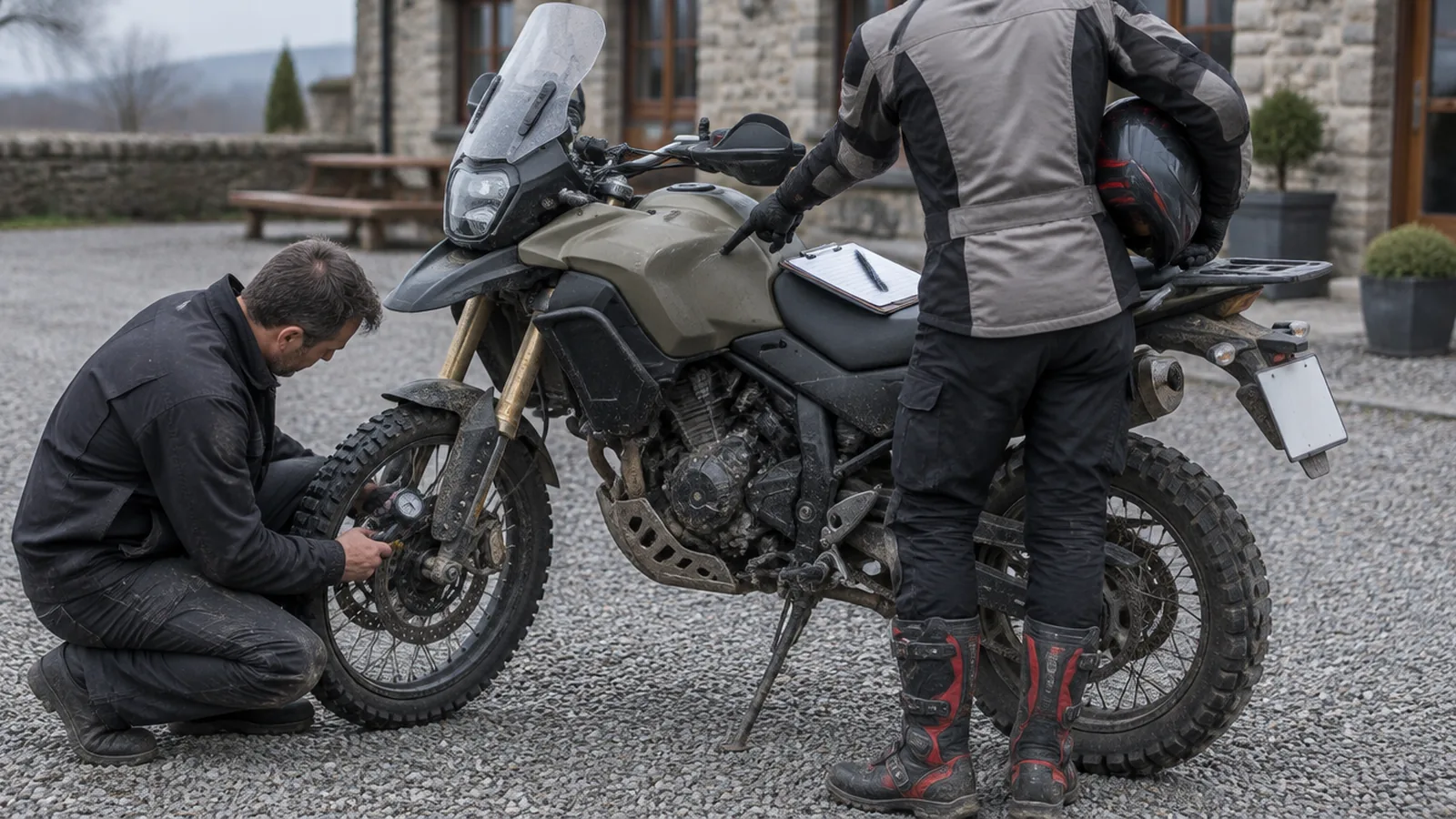
The guidelines expect two things on the first morning, and both are visible. First, the motorcycle. Clause 7.8 says the road-worthy condition of each vehicle is to be certified for each trip, and 7.9 wants a specialist over engine, brakes, lights and tyres before every ride. You can see whether someone walks round the bike with you, works every control, checks the tyre pressures in front of you and writes the existing scratches onto a handover sheet you both sign. If the keys arrive with the words she's fine, the certification in 7.8 happened in somebody's head.
Second, the briefing. Clause 7.17 wants a pre-ride safety briefing covering all aspects of risks and the action to be taken by staff and participants. The topic list is on our group ride page; here is what a good one looks like from the chair. The person who will lead the ride gives it, not the office. It takes twenty minutes, not five. It includes the two items riders flinch at: the indemnity bond that 7.17 lists, and a word about medication and medical history, which 7.18 says you are expected to disclose to the ride leader. A good operator asks. A better one asks where nobody else can hear.
Then ask for a name. Clause 7.22 says an operator must have at least two full-time trained motorcycle trip leaders, each holding valid first aid and CPR certification. One is standing in front of you. Ask who the second is and whether they are on this ride. It is the last point at which changing your mind is cheap.
Day five: the daily checks nobody applauds
By day five the group has stopped being strangers, the roads have got harder and everyone is more tired than they admit. Clause 7.11 asks for a system of daily checks so that a safe motorcycle is available every riding day. The visible form is a mechanic at the bikes before breakfast, not after the first puncture, and a leader who asks whether anything changed under you yesterday. The morning brief should be new every day: today's surface, today's cut-off time for the pass or the water crossing, today's regroup points. The same speech as day one is not a brief.
At altitude the guidelines add a duty. Clause 7.21 says tour leaders must have full knowledge of handling customers at altitude, precautions and emergency procedures included. It shows as the leader asking, every morning, how you slept and whether you have a headache, and meaning it. Our acclimatisation page covers what the answers should trigger.
Watch how the group is counted. Every stop should start and end with a head count, and the sweep rider should not leave until the leader has confirmed the number. Watch, too, how the support vehicle is offered. The rider who is fading on day five, slower, shorter tempered, making small errors, needs a seat in the vehicle offered as routine rather than as a verdict. How that offer is made tells you how the bad day will go.
The bad day: who takes command, and what gets written down
The first-aid part of a crash is covered elsewhere on this site. Clause 7.16 says a detailed action plan should be available with the ride leader, including the contact numbers of emergency services. Available means in a pocket or a tank bag, not on a laptop in an office. In the first minute someone takes charge out loud and the roles split without debate: one person with the casualty, one controlling traffic on the bend, one on the phone. The rest of the group is held together, off the road and clear of the scene.
Then the calls. The ride leader's own plan names the hospital and the number. On a stretch with no network the leader knows where the nearest signal is, or carries a satellite phone that is legal to use in India. Someone who is not the casualty calls the family. Someone calls the insurer's emergency line early, because authorisation for an evacuation takes time.
Then the paperwork. The 2026 Model Framework is a useful yardstick even where it is not law: it wants a preliminary incident report within 6 hours and a detailed one within 72, with a root cause analysis, participant accounts and corrective actions. So when the dust settles, ask whether there is a written incident report and whether you may have a copy. An operator that writes one the same evening is running a system.
What the rule books do not settle
Two things are muddled in the record. The 2018 guidelines cannot agree with themselves on what they cover: the president's letter says eighteen land, seven air and six water activities, the Ministry's note inside the same document says fifteen, seven and seven, and the index lists fifteen, six and seven. The Ministry's 2026 framework says BIS adopted ISO 21101 as IS 17667:2021, while the BIS portal lists it as IS/ISO 21101:2014. And none of it binds the company you booked with unless its state has adopted it, which the Ministry told the Rajya Sabha in April 2026 it has asked every state to do. Which is why you watch the three moments, not the certificate on the wall.
How we run the three days
On our Ladakh expedition day one has no riding at all: bike inspection, permit processing and gentle walking. The lead rider briefs the group each morning on the day's route, surfaces and stops. The support vehicle carries the medical kit and oxygen, a mechanic travels with it, and a satellite phone is carried for the sectors without network. An unwell rider moves into the vehicle, the route is planned so that descent is always possible, and safety decisions sit with the lead rider and are not negotiable.
What to watch for, day by day
- Day one: a walk-round of the bike with you, pressures checked, damage written down, the briefing from the ride leader, and the second leader's name.
- Every morning: a mechanic at the bikes before breakfast and a fresh brief with today's cut-off time and regroup points.
- Every stop: a head count before anyone leaves, and a sweep rider who waits for it.
- Day five: watch how the support vehicle seat is offered to the rider who is fading.
- After any incident: one person in charge, the leader's own plan and numbers to hand, and a written incident report you can ask to see.
Questions riders ask
Are the ATOAI motorcycle tour guidelines legally binding in India?
No. The Ministry of Tourism's 2022 National Strategy files them under Advisory, and in April 2026 the Ministry told the Rajya Sabha they had been circulated to states for adoption. A state can make them binding; the Ministry's May 2026 Model Framework is a template Act for exactly that, and is in force nowhere until a state passes it.
What should a motorcycle tour safety briefing cover?
Clause 7.17 of the 2018 guidelines lists local traffic rules and documents, protective gear, the bike's controls and pre-ride checks, group riding procedure, dangerous surfaces, night riding and fatigue, an indemnity bond, alcohol, and hydration and rest stops. Expect it from the ride leader, not the office, and expect a private question about your medical history.
Does a motorcycle tour operator have to carry a satellite phone?
The guidelines list communication equipment, radio, mobile or satellite phone, as basic kit if applicable, so it depends on the route. In India a satellite phone is permitted only with specific permission from the Department of Telecommunications or as provisioned by BSNL. A foreign handset carried in without that is not legal to use.
What is ISO 21101 and does it apply to motorcycle tours?
ISO 21101:2014 sets out what a safety management system for an adventure tourism provider must contain. It is activity-neutral, so a motorcycle tour operator is covered as much as a rafting one. India adopted it as IS/ISO 21101:2014, and the Ministry's 2026 framework makes an audit against it the condition for registration wherever a state adopts the framework.
Sources
- Adventure Tour Operators Association of India with the Ministry of Tourism, "Indian Adventure Tourism Guidelines 2018, Version 2" (Basic Minimum Standards), 2018, Guidelines for Motorcycle Tour Operators, clauses 7.1 to 7.22, pp. 39 to 43: vehicle certification per trip, specialist review before every ride, daily checks, SOPs, the ride leader's action plan, the pre-ride briefing, medical disclosure, altitude knowledge and the two-trip-leader minimum; president's letter, p. 4, and the Ministry's note, p. 11, on the activity counts. Hosted by the Ministry of Tourism. Link
- Ministry of Tourism, "National Strategy for Adventure Tourism", April 2022, paras 6.2.1 and 6.2.3: the guidelines filed under Advisory, fifteen land-based activities, ISO 21101 and BIS as benchmarks. Link
- Press Information Bureau, Ministry of Tourism, "Regulation of Adventure Tourism", Rajya Sabha reply, 2 April 2026: guidelines circulated to all States and Union Territories for adoption; safety at adventure sites primarily a state responsibility. Link
- Ministry of Tourism, "Model Adventure Tourism Safety Framework", May 2026: a guiding framework for state authorities; mandatory registration; a safety audit aligned to ISO 21101:2014 as a legally binding prerequisite; mandatory insurance; advanced first aid with trauma management for high-risk activities; preliminary incident report within 6 hours and detailed report within 72 hours; the statement that BIS adopted ISO 21101 as IS 17667:2021. Link
- ISO, "ISO 21101:2014 Adventure tourism, Safety management systems, Requirements", published April 2014, last reviewed and confirmed 2025: scope and status. Link
- ISO, "ISO 21103:2014 Adventure tourism, Information for participants", published April 2014, last reviewed and confirmed 2024: minimum information before, during and after the activity. Link
- Bureau of Indian Standards, Know Your Standards record "IS/ISO 21101:2014, Adventure Tourism, Safety Management Systems, Requirements", read 23 October 2026: identical adoption under dual numbering, committee SSD 02. Link
- Bureau of Indian Standards, Know Your Standards record "IS 16312:2015 / ISO 21103:2014, Adventure Tourism, Information for Participants", read 23 October 2026: identical adoption under dual numbering. Link
- Department of Telecommunications, "Restrictions on the use of Satellite Phone", page last updated 10 January 2026, Wayback Machine capture of 12 January 2026: satellite phones permitted only with specific permission from the Department or as provisioned by BSNL. Link
- ADV Pathfinder, "What support is included on an expedition" and the Ladakh expedition page, read 23 October 2026: the no-riding first day, the morning brief, the support vehicle, mechanic, oxygen and satellite phone, and safety decisions resting with the lead rider. Link
Col. Shekhar Attri, SM (Retd.)
@adv_pathfinderFounder and expedition commander of ADV Pathfinder. 20+ years in the Indian Army's Para Special Forces, Sena Medal. About the founder
Go deeper
Ride it with us
Have a question about this?
Ask us directly - no account needed, and we answer with facts about your dates.