Bleeding control after a motorcycle accident: the full method
You've bought the tourniquet. Now picture yourself kneeling on gravel beside a rider in a torn jacket. Would you know if this bleeding is the kind that kills, and what to do about it in the next few minutes? Bleeding control after a motorcycle accident comes down to a few decisions made fast. The bodies that write the guidance don't agree on all of them. Here is each decision, who says what, and where they part ways.
How fast it kills, and what each number measures
In my reel I said three minutes. That's the figure I was taught in Special Forces. The American College of Surgeons, which runs the Stop the Bleed programme, says a person can die from severe blood loss in as little as five minutes. It doesn't cite a study for that number.
The clinical papers measure something else. A 2006 review in the Journal of Trauma found that haemorrhage causes 30 to 40 per cent of trauma deaths, and that 33 to 56 per cent of those deaths happen before the patient reaches hospital. A 2017 study in the journal Shock found the median time to haemorrhagic death was 2.0 to 2.6 hours, but that clock starts at hospital admission, not at the roadside.
So nobody has published the number you want, which is how long a crashed rider on a pass has. The three-minute and five-minute figures are advice from people who train others to act. The papers are measurements of a different thing. Both point the same way: the minutes before help arrives are the ones that decide it, and on a Himalayan road that help can be hours away.
Bleeding control at a motorcycle accident starts with seeing it
Check your own safety first. Stop the Bleed puts that first, and a second casualty on a blind corner helps nobody. Then look for the bleeding that kills. The ACS lists these signs:
- Blood spurting from the wound.
- Blood that won't stop coming out.
- Blood pooling on the ground.
- Clothing or bandages soaked with blood.
- Loss of all or part of an arm or leg.
- Bleeding in someone who is now confused or unconscious.
Riding gear makes this harder. The Stop the Bleed course warns that clothing may hide life-threatening bleeding, and a textile jacket or riding trousers soak up a lot before anything shows. Look at the ground under the rider as well as at the rider. I couldn't find current guidance from any medical body on helmets during bleeding control, so leave that question to your first aid course, not to this page.
Pressure and packing, for the neck, armpit and groin
The ACS order is simple: press hard on the wound, pack it, and use a tourniquet if the wound is on an arm or a leg. For a deep wound, the course says to pack gauze tightly into it until the bleeding stops, then hold pressure until help arrives. The ACS says clothing will do if you have no gauze.
Packing matters most where a tourniquet can't go: the neck, the armpit and the groin. These are the junctional areas. A 2012 study of US military deaths from 2001 to 2011 found that 19.2 per cent of lethal haemorrhage came from junctional wounds and 13.5 per cent from arms and legs. That's combat, not road crashes, but it shows why packing isn't an afterthought.
Haemostatic gauze, which carries an agent that helps blood clot, is a step up. The International Liaison Committee on Resuscitation (ILCOR) suggests using it with direct pressure rather than pressure alone. The military's Tactical Combat Casualty Care (TCCC) guidelines say to hold at least three minutes of direct pressure on it. Stop the Bleed gives no minimum and simply says keep pressing until help arrives.
Tourniquets: where the guidance agrees and where it splits
On the basics, the sources agree. Stop the Bleed puts the tourniquet 2 to 3 inches (5 to 8 cm) above the wound, never over the elbow or knee. Tighten it until the bleeding stops. It will hurt, and the course says so plainly. Note the time you put it on. If one tourniquet doesn't stop the bleeding, a second may be needed. TCCC says to place the second side by side with the first.
They split on clothing. The Stop the Bleed course says a tourniquet can be applied over clothes. TCCC, for care once the casualty is out of immediate danger, says to apply it directly to the skin. TCCC also says that when you can't see where the bleeding is coming from, you place it high and tight on the limb. These are different instructions from two serious bodies writing for different settings. Learn both, and let your instructor show you which one fits the moment.
Then there's how long a tourniquet can stay on. Stop the Bleed tells a bystander one thing: do not remove it. TCCC tells medical staff to try to convert a tourniquet within two hours if other methods can control the bleeding, and not to remove one that has been on longer than six hours without proper monitoring. That second instruction is for clinicians. On the roadside, yours is the first one.
Put it on early. A 2009 study of military casualties found that survival was 90 per cent when the tourniquet went on before the casualty went into shock, against 10 per cent after.
Commercial or improvised
A belt and a stick will do as a last resort. ILCOR suggests first aiders use a manufactured tourniquet rather than an improvised one. It rates that as a weak recommendation on very low certainty evidence, which is honest: the studies are thin. The practical point stands anyway. A purpose-made tourniquet is quicker to put on under stress, and in the first minutes that's what counts.
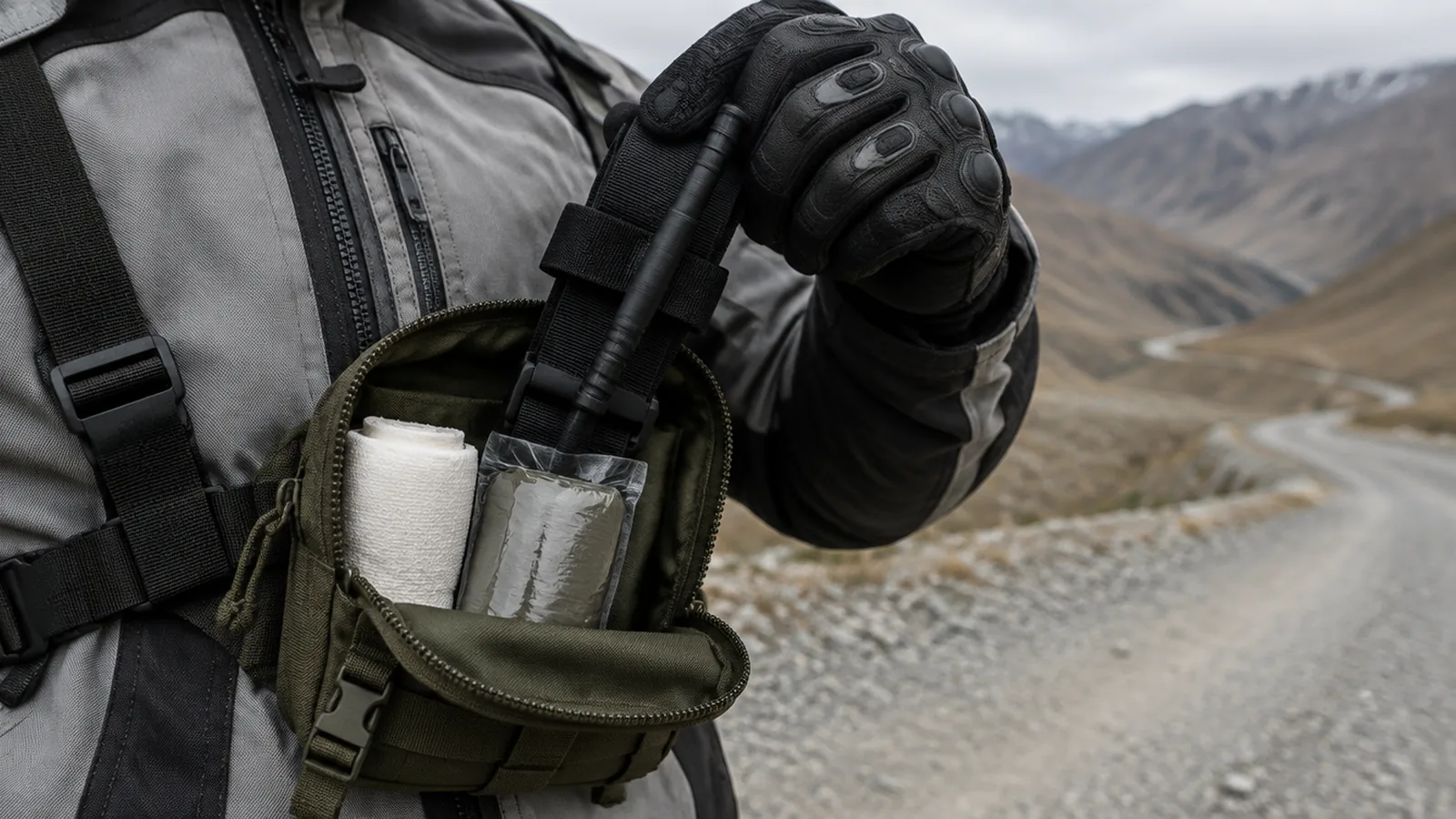
Carry it where either hand can reach it with gloves on: a chest pouch, a jacket pocket, the top of a tank bag. Not at the bottom of a pannier under your spares.
If you stop to help in India, the law is on your side
If you've ever wondered whether stopping at a crash will land you in a police station, the law has answered that. Two-wheeler riders were 44.8 per cent of road deaths in India in 2023, 77,539 people, according to the transport ministry, so this protection matters to every rider here.
Section 134A of the Motor Vehicles Act, inserted in 2019, says a Good Samaritan shall not be liable for any civil or criminal action if the victim is injured or dies because of their negligence in acting or failing to act while helping. A Good Samaritan is anyone who helps in good faith, voluntarily and without expecting a reward. The Supreme Court had already given the ministry's Good Samaritan guidelines the force of law in March 2016.
The Central Motor Vehicles (Twelfth Amendment) Rules, 2020 spell out what that means on the day. If you take a victim to hospital, you must be allowed to leave immediately. No police officer can compel you to give your name or address. You can't be forced to pay for the treatment or fill in admission forms. Being a witness is your choice, and if you agree, the examination should happen once, as far as possible.
Dial 112 for the national emergency line, or 108 for an ambulance, which the National Health Mission says is available in 35 States and Union Territories. High passes often have no mobile signal. On our Ladakh expedition we carry a satellite phone for exactly those stretches.
Before your next ride
- A manufactured tourniquet, carried where either gloved hand can reach it.
- Gauze for packing, haemostatic if you can get it, and a pressure bandage.
- A marker pen to write the time a tourniquet goes on.
- 112 and 108 saved, and a plan for stretches with no signal.
- A hands-on course booked: the Indian Red Cross Society runs a 16-hour standard first aid programme, and Stop the Bleed lists its own classes.
This page explains published guidance. It is not a substitute for training. Learn these skills on a hands-on course with an instructor watching your hands, and follow the medical responders once they arrive.
Questions riders ask
How long does it take to bleed to death after a crash?
The American College of Surgeons says as little as five minutes for severe blood loss. No clinical study measures the roadside figure. Research on hospital patients finds a median of about two hours from admission, which is a different clock.
Can you put a tourniquet over riding gear?
The Stop the Bleed course says a tourniquet can be applied over clothes. The military TCCC guidelines, for care once out of immediate danger, say apply it directly to the skin. Your instructor can show you when each applies.
Is an improvised tourniquet good enough?
It is a fallback. ILCOR suggests a manufactured tourniquet over an improvised one, though it rates the evidence as very low certainty. A purpose-made one is faster to put on under stress.
Can I get into legal trouble for helping a crash victim in India?
Section 134A of the Motor Vehicles Act protects a Good Samaritan from civil or criminal action for injury or death caused by negligence while helping. The 2020 rules say you can leave the hospital immediately and don't have to give your name or pay.
Where can I train in bleeding control in India?
The Indian Red Cross Society runs a 16-hour standard first aid training programme. Stop the Bleed, run by the American College of Surgeons, lists hands-on classes on its own class finder.
Sources
- Col. Shekhar Attri, SM (Retd.), reel on @adv_pathfinder, 2026: the three-minute figure from his Special Forces training. Link
- American College of Surgeons, "May Is National Stop the Bleed Month: Learn How to Save a Life with Three Simple Actions", 5 May 2025: death from severe blood loss in as little as five minutes, and the three actions of pressure, packing and tourniquet. Link
- American College of Surgeons, "STOP THE BLEED Course Version 2", lay public presentation, 2019: own safety first, clothing may hide life-threatening bleeding, packing for neck, armpits and groin with pressure held until help arrives, tourniquet 2 to 3 inches above the wound and not over the elbow or knee, can be applied over clothes, tourniquets hurt, a second tourniquet may be required, do not remove the tourniquet. Link
- American College of Surgeons, Pons and Jacobs, "Save a Life: What Everyone Should Know to Stop Bleeding After an Injury", 2016: the signs of life-threatening bleeding and noting the time a tourniquet is applied. Copy hosted by Region F Coalition. Link
- American College of Surgeons, "Learn How to Save a Life with 3 Steps During National Stop the Bleed Month", 1 May 2024: pack the wound with gauze or clothing. Link
- Kauvar DS, Lefering R, Wade CE, "Impact of hemorrhage on trauma outcome: an overview of epidemiology, clinical presentations, and therapeutic considerations", Journal of Trauma, 2006: haemorrhage causes 30 to 40 per cent of trauma mortality, 33 to 56 per cent of those deaths prehospital. Link
- Fox EE, Holcomb JB and others, "Earlier endpoints are required for hemorrhagic shock trials among severely injured patients", Shock, 2017: median time to haemorrhagic death from admission of 2.0 to 2.6 hours. Link
- Eastridge BJ and others, "Death on the battlefield (2001-2011): implications for the future of combat casualty care", Journal of Trauma and Acute Care Surgery, 2012: lethal haemorrhage by site, junctional 19.2 per cent and extremity 13.5 per cent. Link
- Kragh JF and others, "Survival with emergency tourniquet use to stop bleeding in major limb trauma", Annals of Surgery, 2009: survival 90 per cent against 10 per cent when tourniquets were applied before shock. Link
- Deaton T, Drew B, Montgomery H, Butler F, "Tactical Combat Casualty Care (TCCC) Guidelines 25 January 2024", Journal of Special Operations Medicine, 2024: high and tight when the site is not apparent, directly on the skin 2 to 3 inches above the bleeding site in tactical field care, second tourniquet side by side, at least 3 minutes of pressure on haemostatic dressings, conversion within 2 hours and the 6 hour limit. Link
- International Liaison Committee on Resuscitation, First Aid Task Force, "Control of severe, life-threatening external bleeding in the out-of-hospital setting: Tourniquets", CoSTR, 20 December 2019: manufactured rather than improvised tourniquet, weak recommendation, very low certainty of evidence. Link
- International Liaison Committee on Resuscitation, First Aid Task Force, "Control of severe, life-threatening external bleeding in the out-of-hospital setting: Hemostatic dressings", CoSTR, 20 December 2019: haemostatic dressing with direct pressure rather than direct pressure alone. Link
- Gazette of India, "The Motor Vehicles (Amendment) Act, 2019", No. 32 of 2019, 9 August 2019, section 45 inserting section 134A: no civil or criminal liability for a Good Samaritan, and the definition of Good Samaritan. Link
- Ministry of Road Transport and Highways, "Central Motor Vehicles (Twelfth Amendment) Rules, 2020", G.S.R. 594(E), 29 September 2020, rules 168 and 169: leave immediately, no compelled disclosure of identity, no forced payment or admission procedure, eye-witness by choice, single examination. Archived copy of the ministry file. Link
- Supreme Court of India, SaveLIFE Foundation and Anr v Union of India and Anr, Writ Petition (Civil) 235 of 2012, 30 March 2016: the Good Samaritan guidelines of 12 May 2015 given the force of law under Article 141. Link
- Ministry of Road Transport and Highways, Transport Research Wing, "Road Accidents in India 2023", paragraph 4.14: two-wheelers 44.8 per cent of road accident deaths, 77,539 people. Link
- Ministry of Home Affairs, "Nirbhaya/ERSS Section", read 27 September 2026: 112 as the nationwide single emergency number. Link
- National Health Mission, Ministry of Health and Family Welfare, "ERS/Patient Transport Service", read 27 September 2026: Dial 108 or 102 available in 35 States and UTs, 108 designed for trauma and accident victims. Link
- Indian Red Cross Society, "First Aid", read 27 September 2026: Standard First Aid Training Programme of 16 hours. Link
- Satellite phone on the Ladakh expedition: ADV Pathfinder Ladakh expedition details. Link
Col. Shekhar Attri, SM (Retd.)
@adv_pathfinderFounder and expedition commander of ADV Pathfinder. 20+ years in the Indian Army's Para Special Forces, Sena Medal. About the founder
Go deeper
Ride it with us
Have a question about this?
Ask us directly - no account needed, and we answer with facts about your dates.