Himalayan riding technique: water crossings, loose descents, and an engine with half its power
No riding course taught you this, because no riding course has a Himalayan road in it. Water crossing technique, descending loose gravel with a drop on one side, and riding a motorcycle that has quietly lost a third of its power: that is where Himalaya riding technique stops being theory. The stream the support vehicle splashed through at nine will be a different stream at three.
Why the same stream is a different crossing at three in the afternoon
Most of the water across a Himalayan road is melt, and melt runs on the sun. On the Batal side of Kunzum La, researchers from Jawaharlal Nehru University measured the stream below Chhota Shigri glacier over three Septembers. Discharge peaked at about 2 pm on sunny days, drifted towards 5 pm on cloudy days, and was lowest at about 6 am. They called that stream representative of the melt water streams of Lahaul and Spiti.
It holds under a clear sky. The Jahlma nallah in Lahaul floods in the afternoon without rain, snowfall or even cloud cover, The Wire reported in September 2026. On the Nubra to Pangong road, the Border Roads Organisation's account of a July 2025 rescue records four nallah crossings with regular high discharge and a tourist vehicle stuck in one at about 1600 hrs. When the Kunzum road opened for 2023, the Lahaul and Spiti Deputy Commissioner let traffic through from 8 am to 2 pm. Same clock.
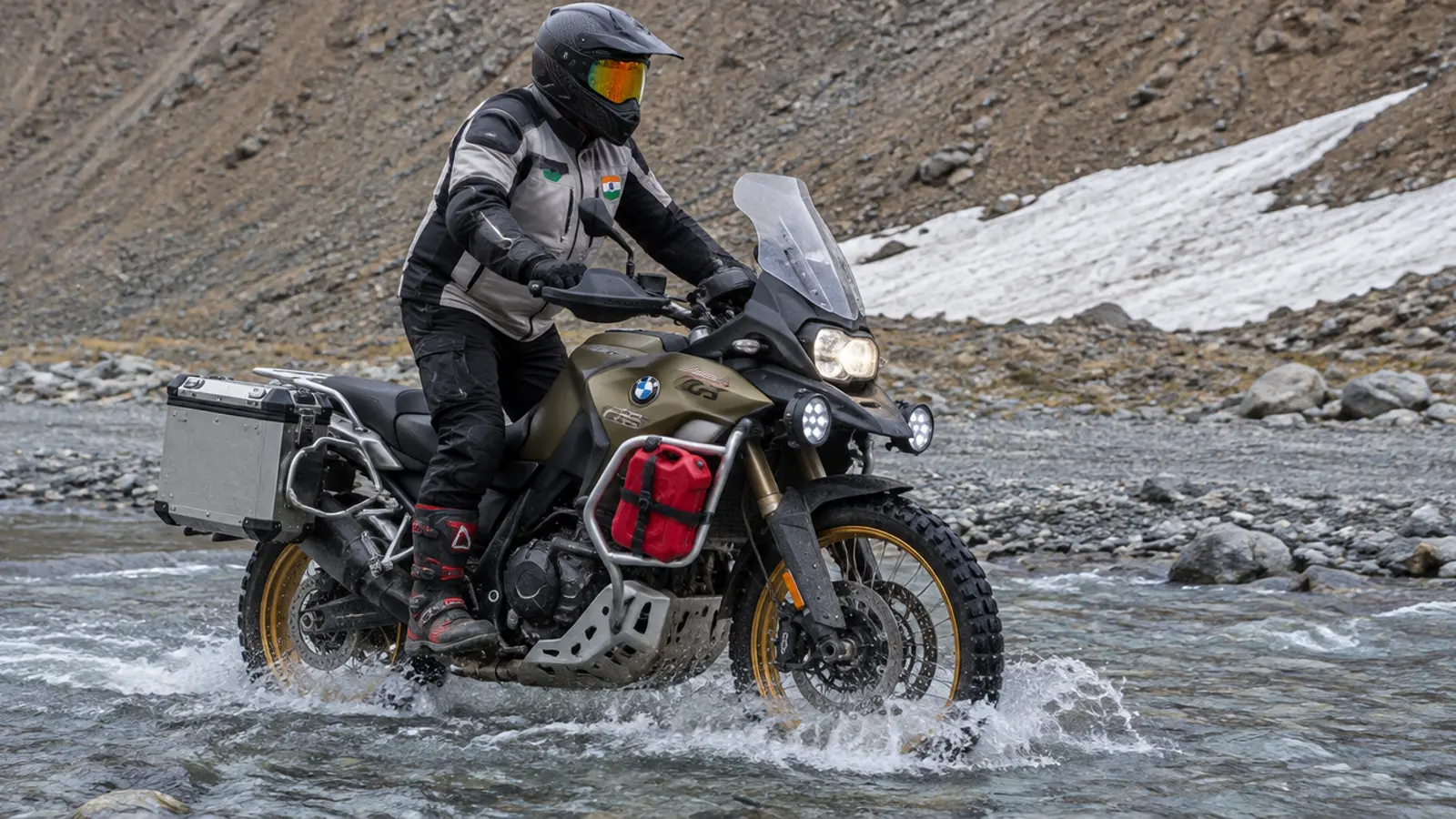
Water crossing technique on a Himalayan road
Walk it first. ADV Pulse's water-crossing guide says to use a long stick or wade in to find the depth before you ride it. You cannot see the hole from the saddle. Pick the line and the exit on foot; the exit is where your eyes stay once you are rolling. Then first gear and a committed throttle: approach at a pace that keeps forward momentum, in ADV Pulse's words, and once you are in, as a 2010 Motorcyclist piece puts it, use enough throttle to keep that momentum and do not close it. No stopping or shifting in the middle. Stand on the pegs if the water looks shallow; between ankle and airbox deep, Motorcyclist's advice is to consider sitting, so a foot is ready to dab. And thumb on the kill switch: if the bike goes over, the engine stops before the intake goes under.
Where your air intake sits, and what happens if the water reaches it
The number you want is wading depth, and no maker of the common tour bikes publishes one. The Himalayan 450 owner's manual says the air filter is located underneath the fuel tank, and Royal Enfield's product page says the intake was put high under the tank so the bike keeps running when rivers are high. No depth. The BMW F 850 GS Adventure manual has you remove the tank cover to reach the air filter. No depth there either. So: intake at tank height, and your bow wave gets there before the still water does.
If water gets past the filter into a cylinder, the piston cannot compress it. The engine stops dead and a bent connecting rod is the usual bill. That is hydrolock. Polaris prints the recovery clearly: do not start the engine. Get to dry ground, dry the airbox, remove the spark plug, turn the engine over on the starter to push the water out, dry or replace the plug, change the fluids promptly. Thumb the starter on a drowned engine and you have turned a wet airbox into a rebuild.
On the far bank your brakes are wet. The UK Highway Code's rule 121 says to test them at the first safe opportunity and, if they are weak, apply light pressure while riding slowly to dry them. The Himalayan 411 manual says the same: ride slowly, applying both brakes intermittently. Before the next bend, not in it.
Going down loose gravel: the rear wheel is the one that lets go
Every descent takes weight off the rear wheel. Under braking, load transfers from the rear axle to the front, and the braking force a wheel can give rises and falls with the load on it, as a Vienna University of Technology study put it in 2001. Point the bike downhill and gravity adds to that transfer before you touch a lever. On loose gravel the rear tyre, now light, is the one that locks and walks sideways.
The Motorcycle Safety Foundation's off-highway guide gives the sequence: both feet on the footrests, point the bike directly downhill, weight to the rear, low gear, throttle closed, brakes applied gradually, in a gear that uses the engine's compression. New Zealand's Ride Forever programme adds the loose-surface bias: in deep gravel, use the rear brake more than the front, and if it gets really deep stand on the footrests to take weight off the front. Both brakes or mostly rear is a real disagreement between those sources. Gradual, low gear, weight back and eyes up are not.
Then the switch on your bike. KTM's description of its Offroad ABS is that ABS is deactivated on the rear wheel, allowing it to lock up, while the front is allowed some slip first. The Himalayan 450 manual lists a Rear ABS OFF setting and only lets you select it at a standstill. KTM adds that the mode demands a significantly higher skill level to maintain control. A locked rear on a straight loose descent is a tool. With the bars turned and a drop on the left it is a different afternoon. If you have never practised with rear ABS off, a Himalayan road is not the place to start.
The engine you ride at 5,000 m is not the one you bought
Air pressure at Leh, 3,500 m, is about 65 per cent of sea level by the standard atmosphere model NASA publishes. At 5,000 m it is about 53 per cent. The power goes with the air, and here the sources stop agreeing. Honda's owner's manuals say horsepower drops about 3.5 per cent for each 300 m of altitude even after rejetting, which puts Leh at about 59 per cent of rated power and 5,000 m at 42. The ISO 1585 standard, as worked through in a 2019 paper from Transilvania University of Brasov, gives a gentler 15 to 18 per cent loss at 3,000 m, and that standard is only admitted down to 0.8 bar, which you pass below 2,000 m. Call it a quarter to two fifths gone by Leh and roughly half on the high passes, and distrust anyone who gives you one tidy number. Fuel injection does not get it back. It keeps the mixture right, which KTM says has made rejetting a thing of the past; a carburetted bike simply runs too rich up here. Either way, the air that is not there is not there.
In the saddle: the gear you climbed a hairpin in at Manali is one gear too high at Taglang La, so shift down before the bend, not in it. Momentum is the thing you cannot buy back, which is why the crossing got a committed throttle. A loaded bike with a pillion feels it first, because the weight did not drop by half when the power did.
How we run it
On our Spiti route the Sach Pass crossing is done early in the day, when the melt streams are lowest, with the support vehicle in company, and our Spiti route page says the same for Gramphu to Batal: before midday. Whoever you ride with, including us, ask when the wheels roll on crossing days and what happens if a stream is up. Waiting for the morning is a plan. Pushing through at four is a hope.
Before a water crossing or a loose descent
- Cross before midday, earlier on a hot clear day. Melt streams peak around 2 pm and are lowest around 6 am.
- Walk it, pick the line and the exit, then first gear and a steady throttle. No stop, no gear change, thumb on the kill switch.
- If the engine drowns, do not touch the starter. Dry the brakes on the far bank before the next bend.
- Descents: low gear, throttle closed, weight back, brakes gradual, the rear doing most of the work.
- Expect roughly half your power on the passes. One gear lower, one bend earlier.
Questions riders ask
What time of day should you cross streams in Ladakh and Spiti?
Morning. Measured melt streams in Lahaul are lowest at about 6 am and peak at about 2 pm on sunny days. Plan the crossing days so the water is behind you by midday, and treat an afternoon arrival at a running nallah as a reason to wait or turn back, not a challenge.
Can a Royal Enfield Himalayan cross a river?
Royal Enfield put the 450's air intake high under the tank for that purpose and says so, but the manual publishes no wading depth. Depth, speed and the wave off your front wheel decide it, not the badge. Walk it, keep it slow and steady, and remember that a stalled, drowned engine must not be cranked.
Should I switch off ABS for a downhill gravel section?
Only if you have practised with it. Off-road modes on KTM, BMW and the Himalayan 450 cut ABS on the rear wheel so it can lock, and KTM's own description says the mode demands a higher skill level. On a loose descent with a drop beside you, a rider who has not trained for a locked rear is safer with it on.
How much power does a motorcycle lose at 5,000 m?
Nobody can give you one number. Air pressure at 5,000 m is about 53 per cent of sea level. Honda's rule of 3.5 per cent per 300 m says about 42 per cent of rated power is left, and the ISO standard extrapolated says more than that. Plan for roughly half, and shift down earlier than feels natural.
Sources
- Ramanathan, Sharma and Jose (Jawaharlal Nehru University), "Discharge variations in Chhota Darra, the melt water stream from Chhota Shigri Glacier, Himachal Pradesh, India", Geophysical Research Abstracts Vol. 9, EGU 2007: discharge peaking at about 2 pm on sunny days and 5 pm on cloudy days, lows at about 6 am, and the stream being representative of Lahaul-Spiti melt water streams. Link
- The Wire, Madhumita Dutta and Parineeta Dandekar, "Curious Case of Jahlma Nallah, a Glacial Stream That Floods in the Sun", 2 September 2026: afternoon flooding without rain, snowfall or cloud, and the bridge lost this June. Link
- Voice of Ladakh (Border Roads Organisation account), "Army jawan rescues two civilians trapped in land cum mud slide outburst on Khalsar-agham-shyok road", 7 July 2025: four major nallah crossings with regular high discharge, and the tourist vehicle stuck at approximately 1600 hrs on 6 July 2025. Link
- The Tribune, "Gramphu-Kaza road opens to civilian traffic from today", 1 June 2023: Deputy Commissioner Rahul Kumar's 8 am to 2 pm window via Kunzum Pass and the requirement to cross by 5 pm. Link
- ADV Pulse, Rob Dabney, "5 Tips To Help You Master Deep Water Crossings", 14 March 2014: use a long stick or wade in to find the depth, start in first gear with enough pace to keep momentum, thumb on the kill switch. Link
- Motorcyclist, Tim Carrithers, "Street Savvy: Parting the Waters", 25 November 2010: hit the kill switch if the intake goes under and the motor dies, keep enough throttle for momentum and do not close it, stand if shallow and consider sitting between ankle and airbox deep. Link
- Royal Enfield, New Himalayan Owner's Manual (UK English), Part No. RAM00819/B, 4 November 2025: the air filter located underneath the fuel tank, the Rear ABS OFF settings, and ABS ON to OFF not allowed while moving; no wading depth given. Link
- Royal Enfield, Himalayan 450 product page (US), "Water Wading", read 13 October 2026: the high air intake under the tank so the bike keeps running when rivers are high. Link
- Royal Enfield, Himalayan Owner's Manual BS-VI (model D3G): driving slowly and applying both brakes intermittently to dry water from the brakes; no wading depth or crossing instruction. Link
- BMW Motorrad, Rider's Manual F 850 GS Adventure, 5th edition, March 2021: the tank cover removed to reach the air filter, and the warning of diminished braking effect after riding through water; no wading depth given. Link
- Polaris, 2025 Sportsman 570 Owner's Manual, P/N 9941908, "Vehicle Immersion": service before starting, dry the air box, remove the spark plug, turn the engine over, dry or replace the plug, change fluids promptly. Link
- GOV.UK, The Highway Code, Rule 121, updated 22 October 2025: brakes may be less effective after deep water, test them, and apply light pressure while driving slowly to dry them. Link
- Ecker and Wassermann (Vienna University of Technology) et al., "Braking Deceleration of Motorcycle Riders", International Motorcycle Safety Conference, Orlando, March 2001 (hosted by the Motorcycle Safety Foundation): load transfer from the rear to the front axle under braking, and maximum braking force rising with vertical wheel force. Link
- Motorcycle Safety Foundation, "Tips and Practice Guide for the Off-Highway Motorcyclist", May 2023: the descending-a-hill sequence, gradual use of both brakes, and engine compression in a low gear. Link
- Ride Forever (ACC, New Zealand), "Different road conditions", read 13 October 2026: rear brake more than front in deep gravel, lower gear, weight to the rear, stand on the footrests when it gets really deep. Link
- KTM, "Offroad ABS", KTM tech guide, read 13 October 2026: ABS deactivated on the rear wheel allowing it to lock, front wheel allowed some slip, and the significantly higher skill level demanded. Link
- BMW Group PressClub, "UPDATE: The New BMW F 750 GS and F 850 GS", 29 October 2018: Enduro Pro mode deactivating the rear-wheel ABS. Link
- NASA Glenn Research Center, "Earth Atmosphere Model - Metric Units", updated 13 May 2021: the troposphere temperature and pressure equations used for the 65 per cent and 53 per cent figures. Link
- Honda, CRF150F owner's manual, "High Altitude Carburetor Adjustment" (copy hosted at bike-parts.fr): horsepower decreasing about 3.5 per cent for each 1,000 ft (300 m) even with carburettor modification, and the over-rich mixture at altitude. Link
- Sandu and Ungureanu, "Evaluation of Engine Performance Corrected to Rating Standards", Bulletin of the Transilvania University of Brasov Vol. 12 (61) No. 2, 2019: ISO 1585 power at 70 kPa (3,000 m) of 0.820 to 0.847 of standard power at 25 C, and the factor admitted only for 0.8 to 1 bar. Link
- KTM, "KTM 250 EXC 2023" model page (New Zealand), read 13 October 2026: fuel quantity set from sensor readings including ambient air pressure, and altitude and temperature compensation making re-jetting a thing of the past. Link
Col. Shekhar Attri, SM (Retd.)
@adv_pathfinderFounder and expedition commander of ADV Pathfinder. 20+ years in the Indian Army's Para Special Forces, Sena Medal. About the founder
Go deeper
Ride it with us
Have a question about this?
Ask us directly - no account needed, and we answer with facts about your dates.